The short answer
Four decisions come before the price.
For commercial oven baking mats, decide whether the baked product needs a solid release surface or open airflow, measure the tray’s flat usable area, match the selected mat to the actual oven cycle, and approve a sample after baking and washing it. A price per piece is useful only when those four conditions are the same across quotations.
01 / Surface choice
Choose the construction from the bake.
A single bakery may need more than one liner. Cookie trays, crusty bread and thin cut-sheet work put different demands on the surface.
| Mat format | Where it starts | What to confirm |
|---|---|---|
| Solid silicone-coated fiberglass | Cookies, macarons, pastries and repeated tray lining where a continuous release surface is needed. | Finished size, thickness, smooth coating, sealed edges and the oven temperature of the selected item. |
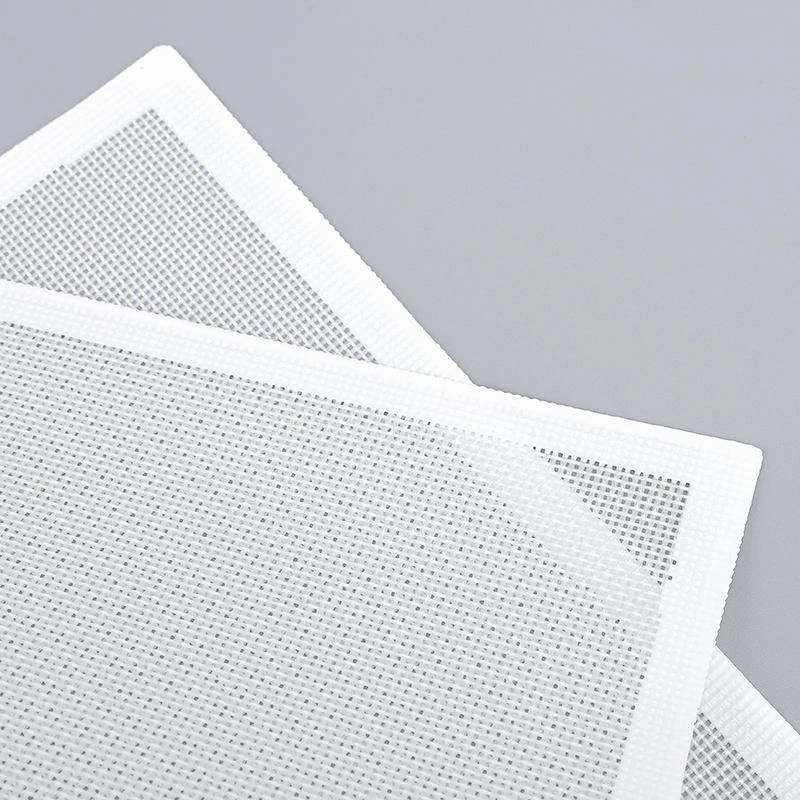
| Open silicone mesh | Bread and pastry programs that need airflow under the product. | Mesh opening, border width, fit on the supporting tray and the baked underside after a trial. |
| PTFE-coated fiberglass | Thin reusable sheets where the buyer prefers a PTFE release surface and a specified cut format. | Coating construction, finished cut, edge quality and cleaning method for the chosen item. |
A smooth fiberglass-reinforced silicone mat and an open silicone mesh are different products. Check the physical sample and the approved specification, even when both are sold as “silicone baking mats.”
02 / Tray fit
The pan’s outside size is not the liner size.
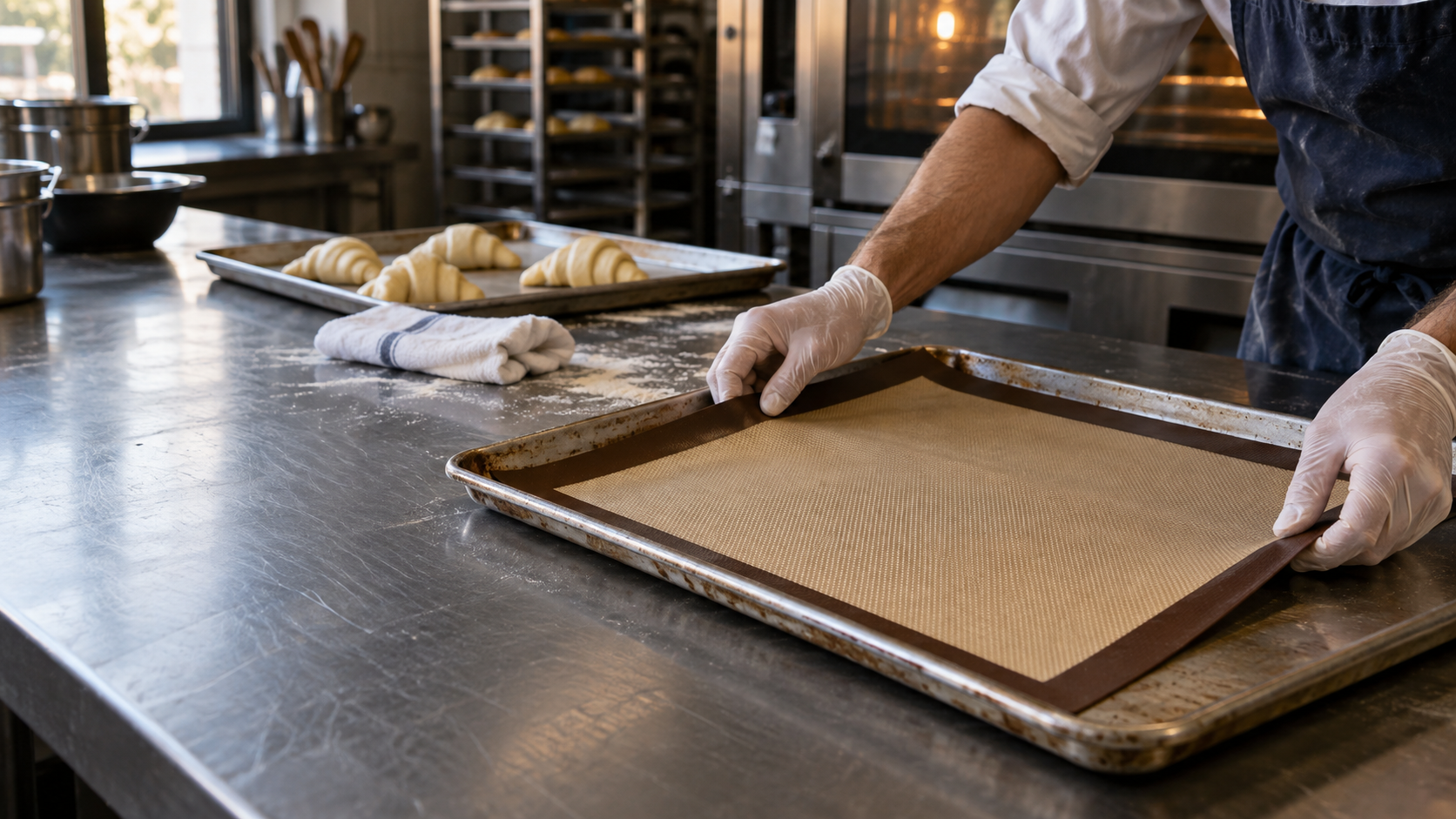
For a 400 × 600 mm bakery tray, 400 × 600 mm is a useful catalog reference. The order drawing should still state the flat area inside the rim. A mat that buckles at the corners slows loading and can disturb a deposited product.
Measure length and width at the flat base, note the corner radius, and leave the clearance your production team uses for lifting and washing. Specify the finished mat size and tolerance, not only the pan name. For reinforced mats, have the edge finished at the required size; do not make bakery staff trim it later.
See the sheet pan size guide
03 / Sample approval
Put the sample through one ordinary production day.
Appearance on a desk tells little about release, underside color or washability. Use the exact food and oven program planned for the order.
Fit it to a real tray
Measure the flat usable area inside the pan, including the corner radius. Set the sample in place and check that it lies flat without climbing the sides or covering drainage points.
Run the real bake
Use the intended food, loading pattern, oven program and normal release method. Compare the underside, browning and sticking against the current liner.
Wash and inspect
Follow the proposed cleaning routine. After repeated cycles, inspect the coating, mesh, printed marks and edges for lifting, fraying or persistent residue.
Lock the approved sample
Keep a signed reference sample and record the finished dimensions, material construction, color, thickness, packing and acceptable tolerances before production.
04 / Repeat-order control
Write down what was approved.
Keep one agreed specification alongside the sample. Record the coating or mesh construction, finished dimensions, thickness, edge finish, color, packing count and labeling. If the mat carries printed guides or a logo, approve the artwork position on a full-size proof.
Request food-contact documents for the selected construction and destination market. A general claim on a catalog page does not identify the test scope of the goods you will receive. Put the required documents on the purchase order so they are reviewed before shipment.
For repeat orders, compare the incoming lot with the signed sample and agreed tolerances. That gives purchasing and the bakery floor the same reference.
05 / Quotation brief
Send a request a supplier can price accurately.
One short brief prevents a thin retail mat, a reinforced bakery liner and a perforated sheet from being quoted as if they were equivalent.
Include these details
- Baked product and whether underside airflow is required
- Oven type, normal set temperature, cycle length and cleaning method
- Tray drawing or measured flat usable area, including corner radius
- Preferred construction, finished size, thickness and edge finish
- Estimated order quantity, sample quantity and repeat-order forecast
- Destination market, required food-contact documents and packing format
- Color, logo or printed marks if they are part of the order
Still comparing surfaces? Send the food and tray dimensions first. A sample plan can be built around those two facts.
Discuss oven baking mats
Buyer questions
Oven baking mat FAQ
Which oven baking mat is best for a commercial bakery?
Choose by the product and process. A solid silicone-coated fiberglass mat suits many cookie and pastry trays; an open mesh format is worth testing when underside airflow matters. PTFE-coated fiberglass is another reusable release surface. Run the shortlisted mat through your actual oven cycle before approving it.
What size baking mat fits a 40 × 60 cm tray?
A 40 × 60 cm mat is a common starting reference, but pan dimensions alone do not prove fit. Measure the flat usable area inside the rim and specify finished mat length, width, corner radius and clearance on the drawing.
Can a fiberglass baking mat be cut after delivery?
Do not plan to trim a reinforced mat in the bakery. Cutting can expose or loosen the fiberglass edge. Order the finished size with an approved edge specification.
What should be included in a wholesale baking mat RFQ?
Send the baked product, oven temperature and cycle, tray drawing or measured usable area, preferred material, target finished size and thickness, estimated quantity, destination market, packaging and any logo or print artwork. Ask for a sample and product-specific food-contact documentation.
Is the highest stated temperature the right basis for selection?
No. Use the operating limit stated for the selected mat construction and test it in the intended oven program. Hot spots, direct contact with heating elements and cleaning practices can affect service life.