The buying decision
Specify the baked result before the mold.
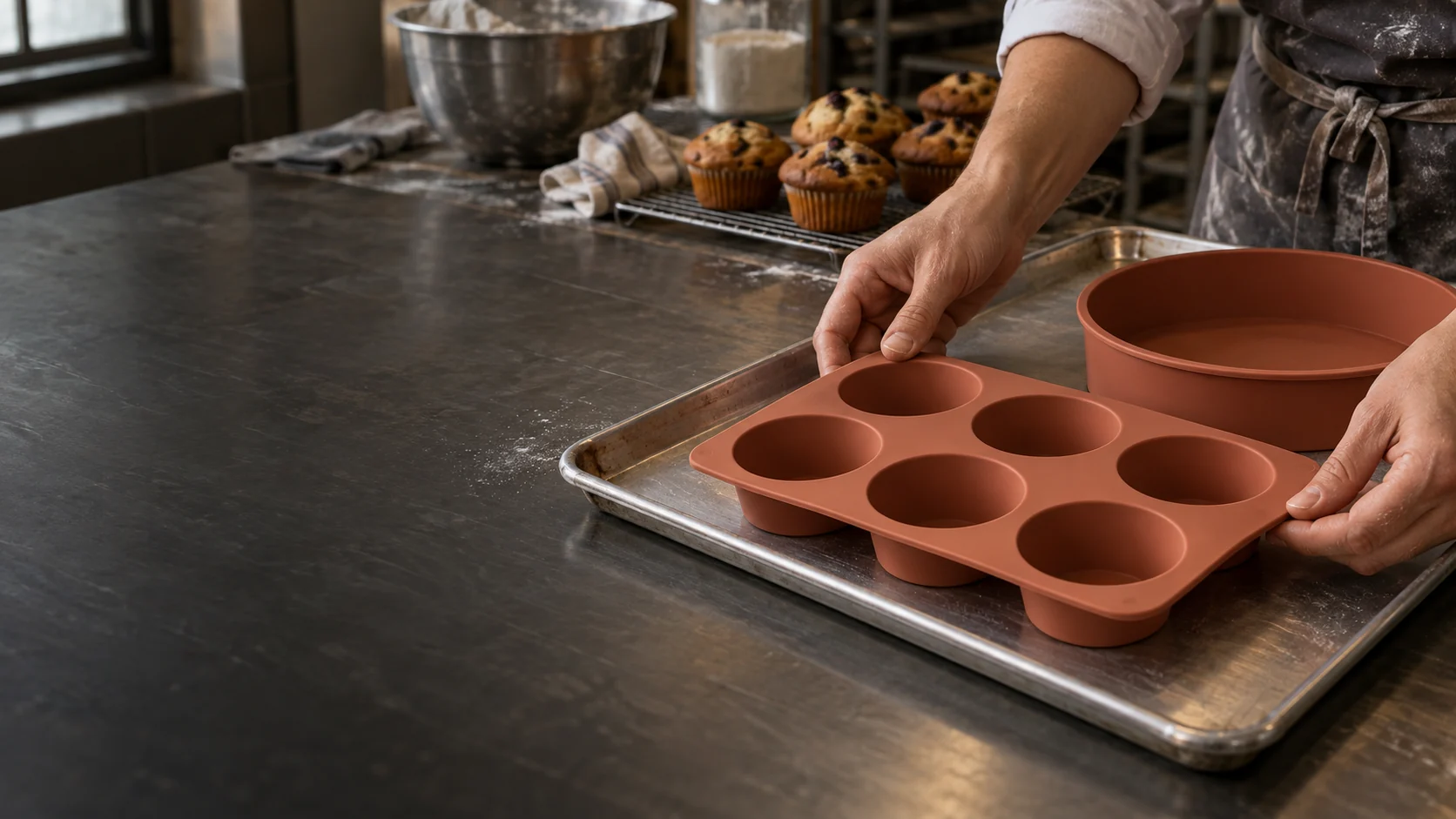
Start with the finished cake or muffin, then work backward to the cavity dimensions, fill level and number of pieces needed per cycle. The mold must also fit a support tray and move through the bakery without spilling or twisting. Approve those points on a baked sample before comparing bulk prices.
01 / Product format
Choose the mold for the job it will do.
“Silicone mold” covers more than one production method. Keep oven baking separate from chilled and confectionery work when you prepare the brief.
One cake or loaf per mold
Check the finished cake diameter or loaf dimensions, pan depth and how a filled flexible pan will be carried. A wider rim can help handling, but it also changes the outer footprint.
See a rectangular cake mold →Several portions per cycle
Cavity count alone does not set output. Internal volume, cavity spacing and the number of molds that fit on a tray determine the real batch size.
See a cake and muffin format →Shape comes first
Fine relief suits chocolate, fondant or chilled desserts, but it does not establish oven suitability. State the actual process and get the selected material and use limit confirmed.
See a confectionery mold →02 / Size and fit
Ask for three sets of dimensions.
A catalog size may describe the whole mold, one cavity or the cake it is intended to make. Put all three on the same drawing so purchasing and the bakery floor are measuring the same thing.
The range includes round cake pans listed at 180, 200 and 230 mm, a six-cup muffin option, and compact rectangular pans listed at 210 × 145 × 65 mm and 225 × 160 × 70 mm. Those figures are starting points. The approved item drawing controls what will be ordered.
03 / Cavity design
A good cavity releases the right product.
Draw the cavity around the food and the way staff remove it. A decorative shape that looks good empty can slow down a production run if the product catches at a sharp detail.
Volume and spacing
Fill every cavity to the same target level during a trial. Check whether the baked pieces are consistent and whether there is room to grip the mold without touching neighboring product.
Walls and corners
Look at the base and sidewall after demolding. Deep relief and tight corners need a real bake test; they can hold crumbs or make cleaning harder.
Rim and support
A flexible mold is easiest to move when it stays level on a rigid tray. Verify that the rim does not sag under the filled load and that the mold can be removed safely after baking.
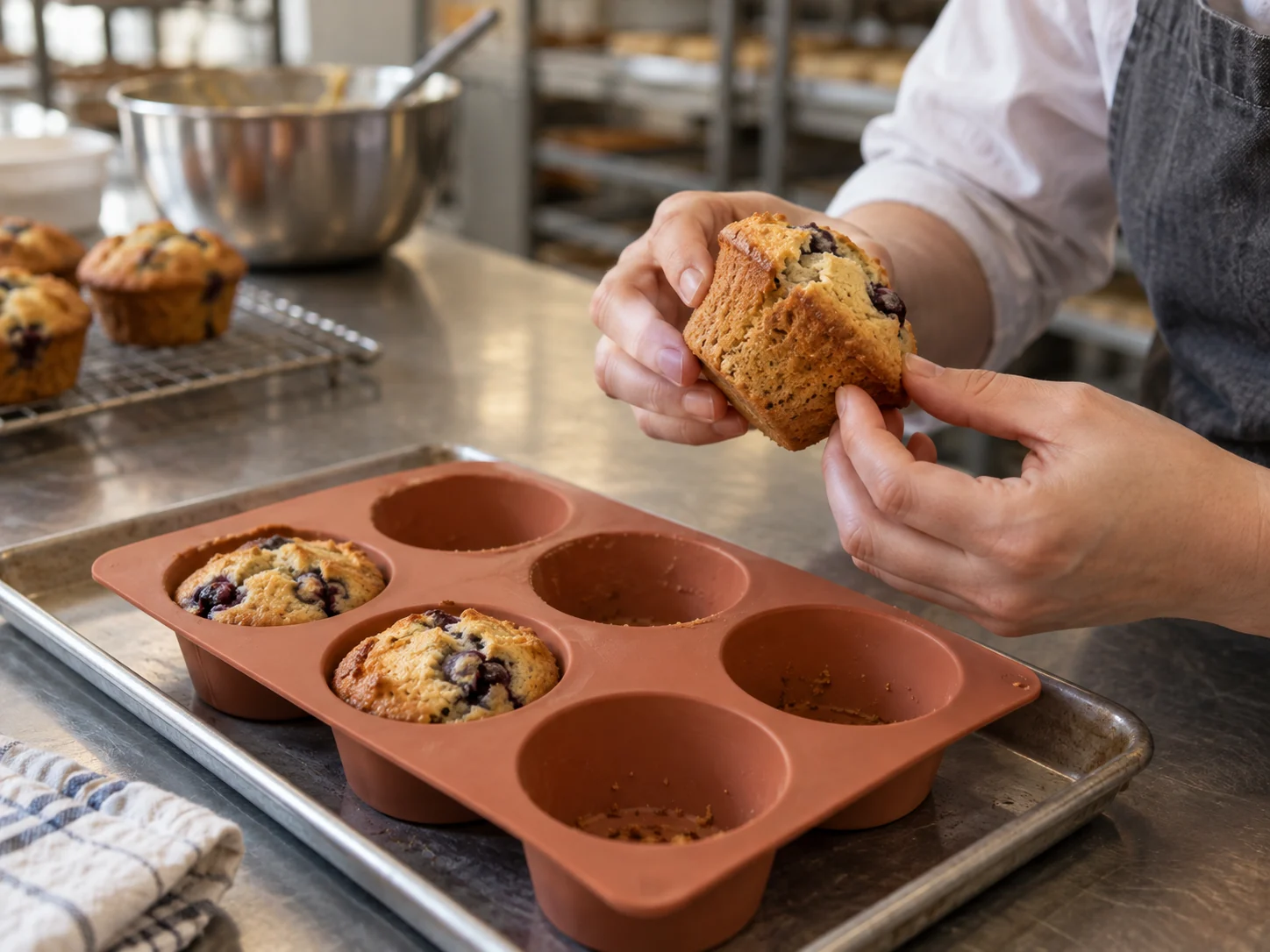 Test with the intended recipe, not an empty mold.
04 / Sample checks
Give the sample one ordinary production run.
Fill every cavity with the intended batter. Carry the loaded mold on its support tray, bake with the normal oven program and allow it to cool the way your team normally works.
- Measure first. Record cavity dimensions, outside footprint, rim and mold weight against the drawing.
- Watch the bake. Check the finished piece size, color and whether the mold holds its shape during transfer.
- Release every piece. Note sticking, torn edges, lost detail and how much handling each cavity takes.
- Wash and inspect. Check corners and relief details for trapped residue, then compare the cleaned sample with the approved specification.
Keep one approved mold and a photograph of the baked result as the reference for repeat orders.
05 / Product approval
Keep the order tied to the tested mold.
Confirm the silicone construction, intended oven conditions and food-contact documents for the selected item and destination market. Do not carry a temperature or compliance claim from another mold into this order.
A quotation-ready brief
Send the mold, the bake and the order details.
A reference product or physical sample is useful, but it does not replace dimensions. Include the finished food you want and the conditions under which the mold will be used.
Discuss silicone baking molds
Buyer questions
Silicone mold sourcing FAQ
Is cavity count enough to choose a wholesale silicone muffin mold?
No. Count tells you how many pieces are baked at once. Check each cavity’s internal dimensions and fill volume, the spacing between cavities and the complete mold footprint on your support tray. Two six-cavity molds can make different finished muffins.
Should a flexible silicone mold sit on a metal tray?
Use a rigid tray for filled flexible molds when moving them into and out of the oven. It keeps the mold level during transfer and makes handling more consistent. Test the exact mold and tray together before placing a bulk order.
Can one silicone mold specification cover both oven baking and cold desserts?
Do not assume it can. State the actual food process and temperature conditions in the brief. A mold used for chocolate or chilled desserts may have a different cavity design and approval scope from a mold intended for oven baking.
What should a buyer check on a silicone baking mold sample?
Measure the cavities and overall mold, fill and bake the intended recipe, move the loaded mold on its support tray, inspect the finished shape and release, then wash and inspect the mold. Keep the approved sample and written specification for repeat orders.
What information is needed for a custom mold quotation?
Send a product reference or drawing, cavity dimensions and count, overall footprint, intended use, expected quantity, destination market, color or branding needs, packaging and document requirements. A physical sample helps when the finished shape is difficult to describe.