The working rule
Start with the tray, then count the cuts.
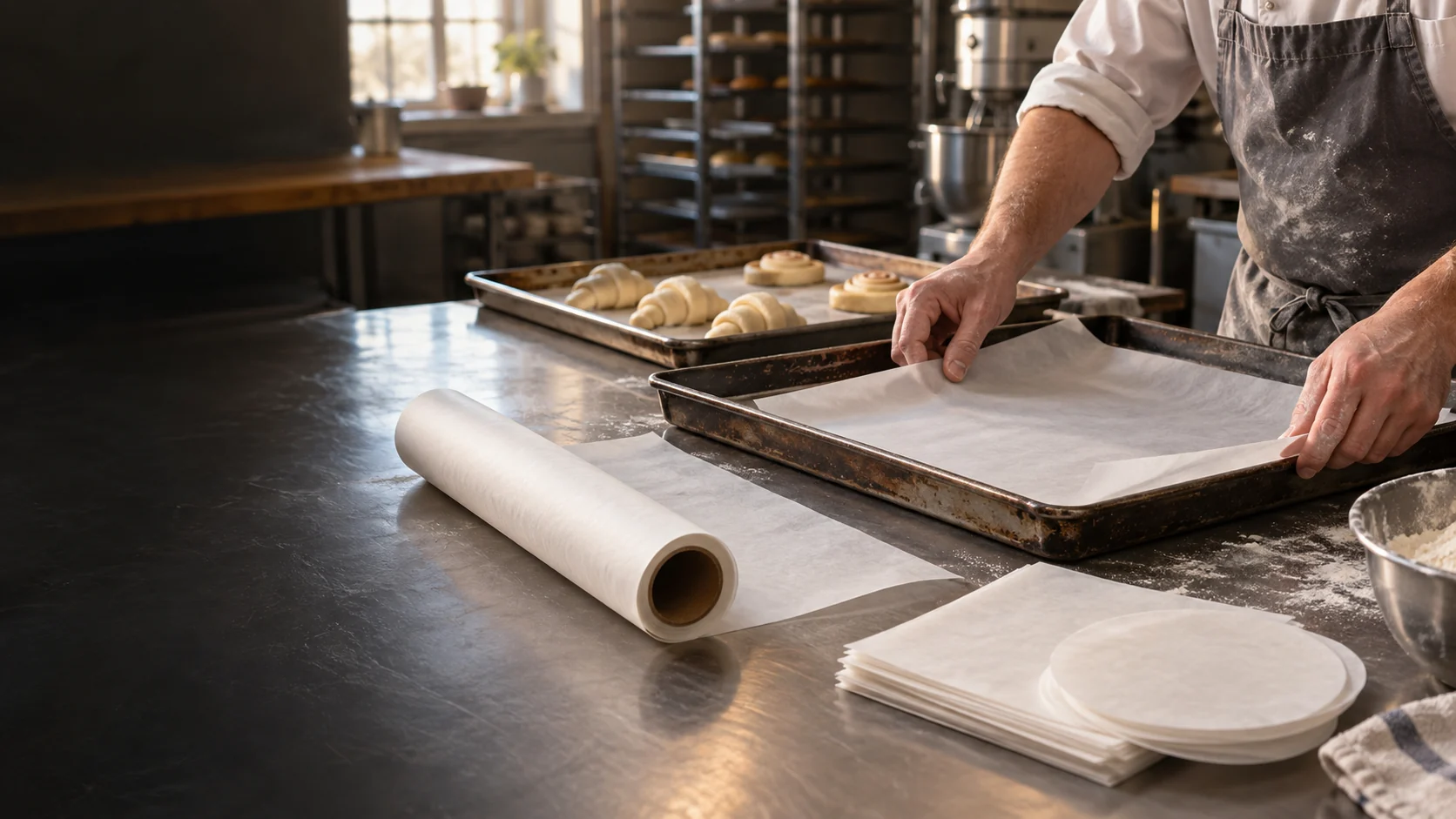
Use flat sheets when the same rectangular trays run all day. Use rolls when paper length changes from job to job. Use pre-cut liners when a fixed pan shape needs a clean, repeatable fit. None of the three wins on unit price alone: include the time spent cutting, offcuts and how reliably the liner sits in the pan.
01 / Format choice
Three formats. Three different jobs.
Buy the format around what operators do at the bench, not just how paper is described in a catalog.
For repeat tray work
Flat sheets
One or two tray sizes account for most of the day. Staff can pull a sheet and load the next pan without measuring or cutting.
For changing lengths
Rolls
A station works across different pan lengths or needs paper for prep as well as baking. Operators cut only the length needed.
For shaped pans
Pre-cut liners
Cake tins, round pans or a fixed production line need the same shape every time. The liner arrives ready to place.
02 / Paper-to-pan fit
“40 × 60 cm tray” is a starting point, not a cut size.
A rimmed tray is measured on the outside, while parchment lies on its flat base. Measure inside the rim at the point where the paper will sit. Check both directions, the corner radius and any clearance your team needs to lift the sheet after baking.
For a round tin, measure the base rather than the wider opening at the top. For a roll, choose a width close to the useful pan width; the operator can then cut the required length without trimming both edges.
More on tray measurements →Record the finished liner
03 / Working cost
Compare cost per lined tray, not cost per roll.
A lower paper price can disappear at the cutting table. During a normal production shift, record how many trays are lined, how long preparation takes and how much paper is discarded as an offcut.
Then compare quotes on the same paper construction, finished coverage and pack quantity. This makes a pre-cut sheet and a roll comparable in the way the bakery actually uses them.
+ cutting and loading time
+ offcuts
Run the check with your real trays and staffing. A price per square metre says little about time at the station.
04 / Specify the paper
Lock the details that affect the bake.
“Parchment paper” does not identify the finished sheet. Agree on the selected paper construction before treating samples and quotations as equivalent.
- Release surfaceConfirm whether the paper is coated on one or both sides and which side faces the food.
- Paper weight and handlingSpecify the selected basis weight and test whether sheets separate, feed and lie flat in your workflow.
- Oven useConfirm the selected grade's temperature limit against the oven program; keep paper clear of direct flame and exposed heating elements.
- Pack and storageAgree on sheets per pack, roll length or core, carton quantity and a dry, clean storage arrangement.
- Destination marketRequest food-contact documentation for the selected paper and intended market before approval.
05 / Sample approval
Test a sample on a busy day.
Keep the current liner as a control, then run the proposed format through the same food, tray and oven cycle.
Load
Time the pull, cut and placement. Note sheets that stick together, roll curl and any trimming at the tray.
Bake
Check release, underside color and the paper's position after the full oven cycle.
Remove
Look for tearing, grease strike-through or paper left under the product when it is lifted.
Approve
Keep the successful sample and record its finished size, paper grade, coating and packing.
Available starting points
Match a format to your next trial.
Product pages show starting formats. Confirm finished dimensions, coating, packing and document requirements on the selected item.
Buyer questions
Parchment format FAQ
Are parchment sheets and pre-cut liners the same thing?
Both arrive cut, but they solve different stocking problems. Standard flat sheets suit repeated rectangular trays. Pre-cut liners are specified to a particular pan shape or finished size, such as a cake-tin circle or a custom rectangular liner.
When is a parchment roll the better choice?
Use a roll when cut lengths change often enough that keeping several sheet sizes creates more handling or waste. Choose the roll width against the working tray, then test the cutter and the actual time spent preparing each pan.
How should a bakery measure a liner for a rimmed tray?
Measure the flat usable area inside the rim, including the corner shape. State the finished paper length and width on the order. The outside dimensions of a tray do not describe where the paper must lie flat.
What should be included in a wholesale parchment paper inquiry?
Send the intended food and oven process, pan dimensions or drawing, preferred sheet, roll or shaped format, finished size, estimated quantity, packing method, destination market and any required food-contact documents. For rolls, include width, length and core details; for shaped liners, include the cut drawing.
A quote that fits the production floor
Send the pan and the paper brief together.
Tell us what you bake, the tray or pan's usable dimensions, the format you prefer, expected quantity, destination market and required packing. A drawing or sample of the current liner makes the first review faster.
- Sheets: finished size and pack count
- Rolls: width, length and core
- Pre-cut: shape, dimensions and any perforation